Thursday, 4 November 2010

Part 4: From World War I to World War II 1920-1945

Introduction
Part 4 of this series covers the period running from 1920 up until the end of World War II in 1945. Works from this era span a wide variety of themes including a reaction against the horrors of the Great War, years of economic boom and bust, the rise of communism and fascism as political forces and the development of modernism as a literary movement. 

The Great War
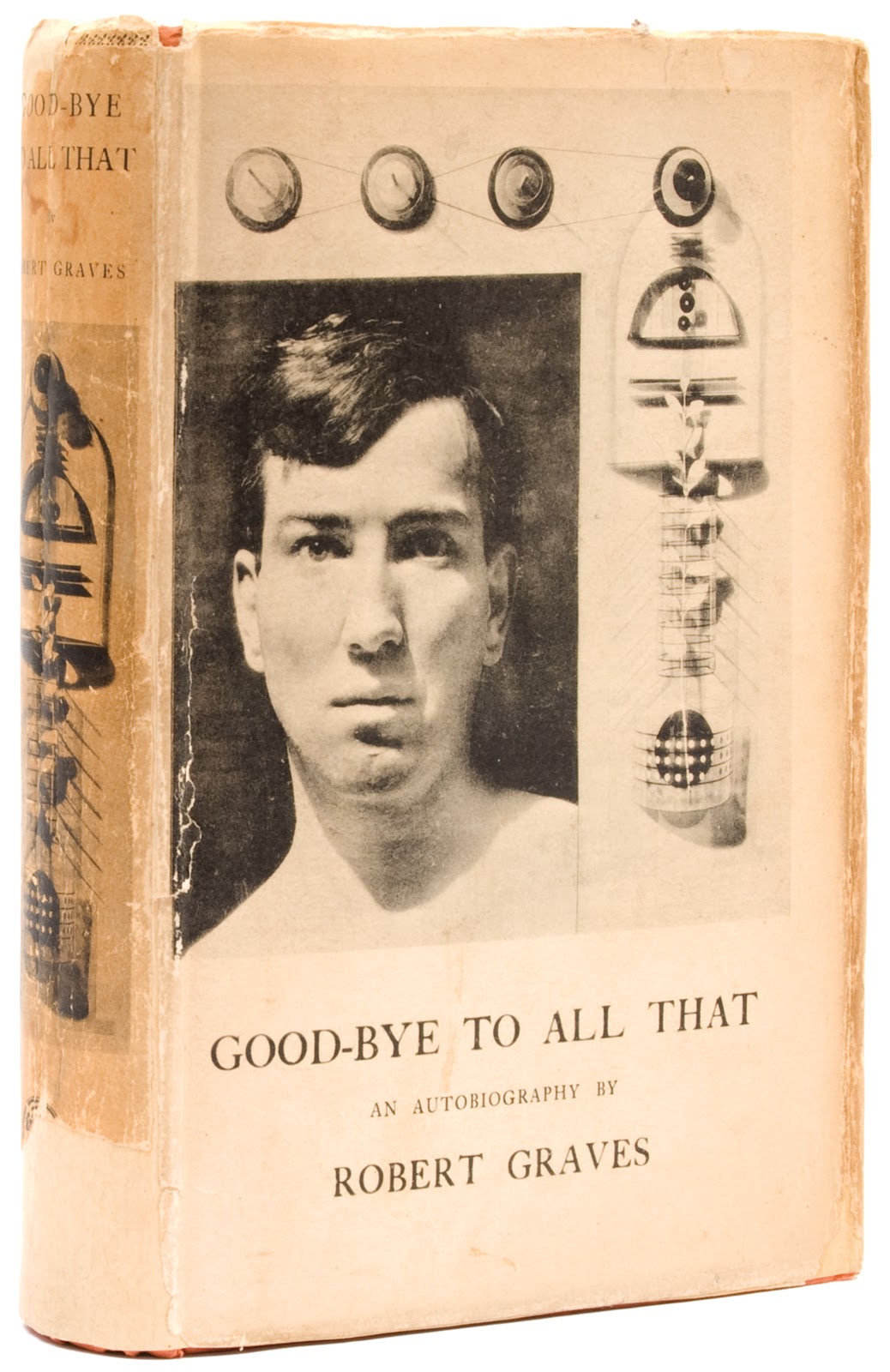
Whilst the work of the war poets (including Rupert Brooke and Wilfrid Owen, neither of whom lived to see the Armistice) provided a more immediate literary reaction against the slaughter of the Great War, over a decade was to elapse before lengthier treatments of the subject began to appear. For example, Robert Graves’ autobiographical Good-bye to All That was published in 1929. Whilst the book covers Graves’ childhood and school years, a large portion of the narrative concerns his war experiences with detailed and vivid descriptions of trench warfare, including the Battle of Loos, coming under enemy fire and gas attacks. The following year Graves’ friend Siegfried Sassoon published the second instalment of his fictionalised autobiographical “Sherston Trilogy”, Memoirs of an Infantry Officer. This follows Sassoon’s alter ego George Sherston from army training school through his experiences in the trenches between 1916 and 1917 to his eventual hospitalisation for shell shock. The novel gives an alternative perspective to many of the events described in Good-bye to All That. This, plus Graves’ unauthorised inclusion in his book of a poem that Sassoon had sent to him in a letter, was a cause of the two authors and former comrades in arms falling out. The book was recalled and Sassoon’s poem is excised from later editions of Good-bye to All That and replaced by asterisks.

Ernest Hemingway adopted a similar fictionalised approach to his semi-autobiographical A Farewell to Arms, published in 1929. Like Hemingway, the novel’s protagonist Frederic Henry is an American who serves as an ambulance driver in the Italian army. The story sets the doomed romance between Henry and an English nurse Catherine Barkley against the broader background of the larger scale tragedy of the conflict. Hemingway was to return to the theme of war with his 1940 novel For Whom the Bell Tolls which tells the story of another young America Robert Jordan who is serving with the International Brigade during the Spanish Civil War.

Virginia Woolf and The Bloomsbury Group
One of the leading figures of modernist literature during the interwar years was Virginia Woolf. Woolf was also a leading light of the informal group of writers, intellectuals and artists known as the Bloomsbury Group that lived or worked in that area of London during the first half of the twentieth century and which also included John Maynard Keynes, E M Forster and Lytton Strachey.

Woolf’s reputation is largely based upon two stylistically innovative novels – Mrs Dalloway and To the Lighthouse – that she published through her own imprint, The Hogarth Press, which she established with her husband Leonard in 1917. Mrs Dalloway details a day in the life of Clarissa Dalloway as she makes preparations to host a party that evening. Although the events described occupy a single day, there are frequent flashbacks and use of the “stream of consciousness” technique to document the momentary inner thoughts of the characters. Owing to these structural and stylistic similarities, Mrs Dalloway is thought by some to be a response to James Joyce’s Ulysses which was published in 1922. Ulysses also concentrates on the events of one day – 16 June 1904 - chronicling Leopold Bloom’s activities in Dublin. Woolf was known to be an admirer of Ulysses describing its cemetery scene as a “masterpiece”. Mrs Dalloway was published three years after Ulysses in May 1925 in an edition of 2,000 copies.

To the Lighthouse, published in 1927, describes the Ramsey family, plus assorted friends and acquaintances, taking a vacation in their holiday home on the island of Skye. With the outbreak of the Great War and various misfortunes that befall the family, the home lies empty for a decade years before some of the surviving characters reassemble at the house in the novel’s concluding section. Again, Woolf’s focus is on revealing the characters’ thoughts and feelings. Woolf conceived of the novel during one of her regular walks around Bloomsbury’s Tavistock Square where she lived at number 52 between 1924 and 1939 and a bust has been erected near her former home by the Virginia Woolf Society to commemorate this event. 

The dustjackets for both Mrs Dalloway and To the Lighthouse were designed by Woolf’s sister Vanessa Bell and their simple designs painted in black, offset with one subdued colour, did much to establish The Hogarth Press’ visual identity. Jacketed copies command a premium price at auction – for example in October 2009 a jacketed copy of Mrs Dalloway fetched $18,000 at Swann Galleries in New York.

The “Bright Young Things”
Following the end of the Great War, the 1920s were a period during which economic and industrial development soared and jazz music and dancing became popular. The “Roaring Twenties” were a time during which a small group of young aristocrats and socialites were able to throw lavish parties, drink heavily and generally enjoy hedonistic lifestyles from which a number of writers drew inspiration with differing approaches to the subject matter.

P G Wodehouse’s novels from this period focus upon the foibles of the upper classes with his Jeeves and Wooster series of comic masterpieces being particularly sought after by collectors. After rising late the indolent and slow witted - yet generous and good natured - aristocrat Bertie Wooster spends a largely carefree existence at his club - the Drones – or staying with friends and relatives at their country houses. However, he is regularly reliant upon the efforts of his resourceful and intelligent “gentleman’s personal gentleman” Jeeves to extricate him from a series of awkward and difficult situations. One particularly amusing Jeeves and Wooster story “The Purity of the Turf” appears in The Inimitable Jeeves, published in 1925 where the pair seek to profit by gambling upon on the events at a village school fete. Much of the amusement in these stories derives from Jeeves’ marvellously understated responses to his younger master.

The humour in Evelyn Waugh’s novel Vile Bodies, which takes as its subject matter the group of wealthy socialites known as the “Bright Young Things” is more satirical in nature. It follows the exploits of aspiring novelist Adam Symes and his on-off engagement to fiancée Nina Blount. A number of humorous incidents arise, particularly after Symes finds employment writing the Society column for the “Daily Excess”. He uses the column for his own amusement as a vehicle to popularise the wearing of green bowler hats and the creation of fictitious stars of the social scene such as “Count Cincinatti”. The later sections of the novel, thought to have been written after the break up of Waugh’s marriage, take on a much darker tone. Vile Bodies was published in 1930, the year that Waugh converted to Catholicism and this is an influence that becomes more apparent in his subsequent works such as Brideshead Revisited (1945).

In America, the decadence and materialism of this period is captured in F. Scott Fitzgerald’s masterpiece The Great Gatsby published in 1925. Here the shallow and amoral Buchanans (who represent the “old aristocracy”) are contrasted with the ambiguous character of the enigmatic Jay Gatsby who, having made his fortune through bootlegging, holds extravagant parties at his Long Island mansion. The dustjacket of the American first edition is a particularly celebrated piece of jacket art with Francis Cugat’s Art Deco-style image depicting a pair of disembodied woman’s eyes and mouth hovering in the night sky over the lights of an amusement park. A closer inspection of the pupils reveals a pair of tiny reclining nude figures. Ironically for a work that questions materialistic values, the presence of this jacket can add tremendously to the value of this sought after title with copies fetching up to £90,000.

The Depression
The boom years ended when the economies of the Western World suffered a spectacular downturn following the Wall Street stock market crash of October 1929, which signalled the start of a 10-year slump. In the American Mid West this depression was exacerbated by the “dust bowl” conditions that were created by a combination of drought and unecological agricultural practices which rendered vast areas of farmland useless.

One of the key works to emerge from this period was John Steinbeck’s Grapes of Wrath which describes the plight of the Joad family who, after their farm in Oklahoma is repossessed, set out for California lured by the promise of work on the fruit farms. Upon arriving in California they find that there is an oversupply of migrant labour and the workers are attempting to form unions to protect themselves from exploitation. The novel was published in 1939 and gained Steinbeck the Pulitzer prize the following year. From a European perspective, the poverty suffered by many during this period was documented in George Orwell’s first full length work Down and Out in Paris and London, published in 1933, which describes his experiences working in poorly paid jobs in restaurant kitchens in Paris and, following his return to England, living rough on the streets. Today this title, which was issued by Gollancz in an edition of 1,500 copies is one the most valuable of Orwell’s works with jacketed copies fetching upwards of £2,500.


The Rise of Totalitarianism
The harsh economic conditions were one of the factors that led to the rise of the Nazi party in Germany with Hitler becoming Chancellor in 1933. This period is captured in Christopher Isherwood’s short novel Goodbye to Berlin. Although it was first published by The Hogarth Press in 1939, it is set in the period 1930 to 1933 and its cast of characters, which include the Jewish heiress Natalia and gay couple Peter and Otto, features a number of individuals who would face persecution at the hands of the Nazis.

Following the Russian Revolution in 1917 and particularly after Lenin’s death in 1924, the communist regime under Stalin took the Soviet Union down a similar path towards totalitarianism. This period of Soviet history forms the basis of Orwell’s memorable allegory Animal Farm. After overthrowing their human masters on the farm, the animals’ revolutionary ideals are betrayed by wickedness and greed as the tyrannical Napoleon, a fierce Berkshire pig, establishes himself as dictator. The novel was published in August 1945 just over 3 months after the end of the Second World War in Europe and, as such, was one of the first works to be critical of our wartime Soviet allies. The subsequent Cold War was to have a significant influence on literature in the post-war period, particularly in the spy fiction genre. 


FROM WORLD WAR I TO WORLD WAR II: 1920-1945 – SELECTED BIBLIOGRAPHY


A guide to current values of first editions in Very Good condition (with dustjackets).
Joyce, James: ULYSSES
            (Shakespeare and Company, Paris, 1922) (First printing, copies 1-100 printed on
            Dutch handmade paper, signed by the author)................................…£100,000+
Wodehouse, P.G.: THE INIMITABLE JEEVES
(Herbert Jenkins, 1923)…….…………………………......£80-£100 (£1,000-£1,500)
Ditto as JEEVES (George H. Doran, US, 1923)…..…...£80-£100 (£1,000-£1,500)
Fitzgerald, F. Scott: THE GREAT GATSBY
(Scribner’s, US, 1925)(First issue)….…..….......£2,000-£3,000 (£50,000-£90,000)
Ditto (Chatto & Windus, 1926)………..…………........£300-£400 (£2,000-£3,000+)
Woolf, Virginia: MRS DALLOWAY
(Hogarth Press, 1925)…….……………….……….……........£600-£800 (£15,000+)
Woolf, Virginia: TO THE LIGHTHOUSE
(Hogarth Press, 1927)…….……………….……….……........£300-£500 (£10,000+)
Graves, Robert: GOOD-BYE TO ALL THAT
            (Jonathan Cape, 1929)………………………….….………£80-£100 (£1,000-£1,250)
Hemingway, Ernest: A FAREWELL TO ARMS
            (Scribners, US, 1929)…………………………...…..……£300-£400 (£2,500-£3,000)
Sassoon, Siegfried: MEMOIRS OF AN INFANTRY OFFICER
            (Faber & Faber, 1930)…………..………………...…..…………£25-£30 (£150-£200)
Waugh, Evelyn: VILE BODIES
            (Chapman & Hall, 1930)…………………………....…..£300-£500 (£6,000-£8,000+)
Orwell, George: DOWN AND OUT IN PARIS AND LONDON
(Gollancz, 1933)…….………………………….......................£200-£300 (£2,500+)
Ditto (Harper, US, 1933)…………………………….....…........£100-£200 (£1,000+)
Isherwood, Christopher: GOODBYE TO BERLIN
            (Hogarth Press, 1939)………………………….............£90-£120 (£1,500-£2,000)
Steinbeck, John: THE GRAPES OF WRATH
(Viking, US, 1939).……..…..…………………….............£75-£100 (£3,000-£4,000)
Ditto (Heineman, 1939).……..………..………….….......……….....£20-£30 (£500+)
Hemingway, Ernest: FOR WHOM THE BELL TOLLS
            (Scribners, US, 1940)……………………………...……...…..£50-£75 (£750-£1,000)
Orwell, George: ANIMAL FARM
(Secker & Warburg, 1945)…….…………………………...............£60-£80 (£1,500)
Ditto (Harcourt Brace, US, 1946)…………….…………...…......£20-£30 (£80-£100)

Part 5: Modern first editions from 1945 to 1980


Wednesday, 3 November 2010

Part 3: The start of the modern period 1890-1920

Introduction
In part 3 of this series we look at the period between 1890 and 1920, which encompasses the end of the Victorian era and the beginnings of the modern novel. We will be focussing on some key works of fiction which represent the main literary movements and embody the common themes of the time. As such, these titles tend to command premium prices.

This was also a period which saw the decline of the “three-decker” or three volume novel as the standard publishing format and the rise of the single volume that dominates today.

Morality, Sexuality and Censorship
The Victorian era is closely associated with the suppression of sexuality and adherence, at least outwardly, to a strict moral code and many leading authors from this period sought to challenge this restrictive outlook through their fiction. For example, Thomas Hardy’s Tess of the d’Urbevilles attracted criticism for its sympathetic portrayal of a woman who loses her virginity before marriage. Originally serialised in The Graphic, it was first published in book form in 1991 as a three volume work in an edition of only 1,000 copies.

The outcry against Hardy’s next novel Jude the Obscure, with its frank treatment of sex and apparent attacks on the institution of marriage, was even more vocal with many booksellers selling copies in brown paper bags. The Bishop of Wakefield, William Walsham How, even went so far as publicly burning a copy. Hardy later wrote that this was “probably in his despair at not being able to burn me”. This negative reaction is thought to have been a factor in Hardy’s subsequent abandonment of fiction in favour of poetry.

Oscar Wilde’s only novel The Picture of Dorian Gray was first published as a book in the same year as Hardy’s Tess, having previously been published in a shorter form in the July 1890 edition of Lippincott’s Monthly Magazine. Some of the critical reaction to the Lippincott version was extremely unfavourable with The Scots Observer describing it as suitable for “none but outlawed noblemen and perverted telegraph boys” – a reference to the Cleveland Street Scandal of 1889 where the police raided a homosexual brothel in Fitzrovia said to have been frequented by the aristocracy and staffed by rent boys who also worked as messengers for the post office. With homosexuality being illegal in England at this time (a situation which remained until 1967) Wilde removed many of the more overtly homoerotic passages prior to the novel’s publication in book form by Ward Lock in April 1891, particularly those relating to the artist Basil Hallward’s admiration for the subject of his portrait. However, they were still apparent to contemporary reviewers and the book was used in evidence against Wilde at his trial for gross indecency in 1895 which resulted in him receiving the maximum sentence of two year’s hard labour.

The attitude of the authorities towards the portrayal of sexual relationships generally in fiction were slow to change during the early part of the twentieth century with D H Lawrence being another author to experience this. His 1915 novel The Rainbow follows the fortunes of three generations of the Brangwen family focussing on the sexual dynamics of the main characters. Although it might be judged tame by contemporary audiences, the novel’s candid treatment of sex caused a furore upon publication and it was the subject of an obscenity trail in late 1915, which lead to it being banned and copies being seized by the police and burned. Although editions were published in the States it would not be available in Britain for another 11 years.

James Joyce also experienced difficulties in getting his semi-autobiographical novel A Portrait of the Artist as a Young Man published, with several English printers refusing to handle it “on moral grounds”. It was first published by the New York firm B W Huebsch on 29 December 1916 with the first English edition, produced from 750 sets of the American sheets, being published the following year by Harriet Weaver of The Egoist Press priced at 6 shillings. The Egoist edition was issued in a dustwrapper, but this is so rare today that it can add a substantial premium to the price. A jacketed copy “rubbed and marked, with crude sellotape repairs and loss at spine ends” sold for an incredible £31,050 in December 2003 at Dominic Winter Book Auctions.

It was not until 1959, when the defence of artistic merit was introduced in the Obscene Publications Act and subsequently tested in the trial against Penguin Books for publishing an unexpurgated version of Lady Chatterley’s Lover that publishers and authors began to enjoy greater freedom from censorship.

Class
The Victorian era also saw a marked expansion in the economy and the growth of the cities which led to the rise of a middle class of professionals, administrators and clerks and the suburbs in which they lived. The outlook and attitudes of this burgeoning social group were satirised in George and Weedon Grossmith’s The Diary of a Nobody, which was published by the Bristol publishers Arrowsmith in 1892, having originally been serialised in Punch. This comic classic takes the form of a diary in which snobbish and small-minded commercial clerk Charles Pooter documents the banalities of his daily struggles with the various tradespeople who service his house, his efforts to find gainful employment for his son Lupin and Lupin’s relationship with the unsuitable Daisy Mutlar. The humour derived from Pooter’s gauche behaviour is heightened by Weedon Grossmith’s illustrations, which did not feature in the Punch columns.

Moving into the Edwardian era, E M Forster’s novels also focus on the hypocrisy of the middle class. A Room with a View, published in 1908, highlights the narrow-minded views of English tourists abroad with the novel’s central character Lucy Honeychurch being presented with a choice between the repressed Cecil Vyse and the free-thinking George Emerson. In Howard’s End, which appeared two years later, Forster examines the relationships between three different groups within the middle class, represented by the capitalist Wilcoxes, who have made their fortune in the colonies, the intellectual Schlegels, who bear a resemblance to the Bloomsbury Group, and the struggling lower middle class Basts.

The idea of social class is also central to an appreciation of D H Lawrence’s Sons and Lovers, published in 1913. Gertrude Coppard, the daughter of a “good old burgher family” marries miner Walter Morel after meeting him at a Christmas dance. However, she soon grows to appreciate the difficulties of living in a rented house off his meagre wages and they begin to drift apart. Later her son William leaves their Nottinghamshire home for a job in London and begins to rise up the middle class.

Imperialism
By the end of Victoria’s reign, the British Empire extended over approximately a fifth of the world’s surface and around a quarter of the population, theoretically at least, owed allegiance to the Queen. Joseph Conrad’s works from this period explore and question the ideology of imperialism. For example, Lord Jim, published in book form in October 1900, concerns an adventure at the height of the empire. Jim, who is first mate on the ship Patna, is complicit in abandoning the ship and its passengers, who are Moslem pilgrims bound for the Hajj in Mecca. Whilst Jim eventually atones for this lapse he remains an ambigous figure and Conrad’s use of a protagonist with a dubious history has been interpreted by some as an expression of his doubts about the empire’s mission. Today Lord Jim is one of the most prized of Conrad’s novels.

Criticism of imperialism is more overt in Conrad’s novella “Heart of Darkness”, in which Marlow (who also serves as the narrator in Lord Jim) takes an assignment as a ferry-boat captain to navigate up the Congo River and relieve the ivory trader Kurtz. Upon arriving at the Inner Station, Marlow discovers that Kurtz has established himself as a god with the natives using brutal methods to obtain his ivory. Originally serialised in Blackwood’s Magazine between February and April 1899,”Heart of Darkness” was published in 1902 in a volume of three stories entitled Youth: A Narrative and Two Other Stories. Given the importance of the story to modern literature it is perhaps surprising that it was not chosen as the title for the collection. Conrad’s anti-heroic characters have influenced a number of authors and the themes of many of his novels makes him a forerunner of modernism.

The Dawn of Modernism
Modernism was a movement that increasingly took hold in the aftermath of World War I – an event that shook many people’s belief in the nature of Western civilisation and culture. In literature it manifested itself as a revolt against traditional literary forms and, thematically, an increased focus on individualism, mistrust of the institutions of government and the absence of absolute truths.

One of the founding fathers of English modernism was Ford Madox Ford whose finest work is generally considered to be The Good Soldier. This story of adultery and deceit focuses on two couples, Edward and Leonora Ashburnham, and their two American friends, John and Florence Dowell. By presenting the story through John Dowell, Ford makes use of the technique of the unreliable narrator and the groundbreaking narrative style influenced many later authors, most notably Graham Greene. Ford (who was born Ford Hermann Hueffer) published The Good Soldier under the name Ford Madox Hueffer. With German connotations becoming unpopular after Word War I he eventually settled upon Ford Madox Ford in 1919.

James Joyce was also a leading figure in modernist literature and many of the innovative techniques that he would later develop in Ulysses and Finnegan’s Wake are apparent in A Portrait of the Artist as a Young Man, published in book form in 1916. The novel portrays the formative years of Joyce’s fictional alter ego Stephen Dedalus and his rebellion against the Irish Catholic conventions in which he has been raised, eventually leaving Ireland to follow his calling as an artist.

Enduring Reputations
Whilst almost all of the authors and works covered here will be familiar to contemporary readers, some have not stood the test of time so well, with perhaps the best example being Marie Correlli. Although regularly derided by critics, up until World War I her works were bought in vast quantities and outsold the combined sales of Conan Doyle, Wells and Kipling. Her novels include Wormwood: A Drama of Paris, a lurid melodrama which warns of the perils of absinthe, and The Sorrows of Satan, the faustian story of penniless author Geoffrey Tempest and his temptation by Lucio, an incarnation of the devil. Whilst Corelli’s novels are still collectable today it is worth bearing in mind that, as reading tastes change and the importance of various authors is continually reassessed over time, the value of their books to the collector is unlikely to remain static.


THE EARLY MODERN PERIOD: 1890-1920 – SELECTED BIBLIOGRAPHY


A guide to current values of first editions in Very Good condition (with dustjackets).

Corelli, Marie: WORMWOOD: A DRAMA OF PARIS
(Richard Bentley & Son, 1890)…….……………….……………........£750-£1,000
Hardy, Thomas: TESS OF THE D’URBEVILLES
(Osgood, McIlvaine & Co, 1891)………………………………........£5,000-£8,000
Wilde, Oscar: THE PICTURE OF DORIAN GRAY
(Ward Lock, 1891)………………………………………..…...............£750-£1,000
Grossmith, George & Weedon: THE DIARY OF A NOBODY
(Arrowsmith, 1892)……………………………………………….............£100-£150
Corelli, Marie: THE SORROWS OF SATAN
(Methuen, 1895)……………………………..……………………...........£200-£250
Hardy, Thomas: JUDE THE OBSCURE
(Osgood, McIlvaine & Co, 1896)………………………………...….........£200-300
Conrad, Joseph: LORD JIM: A TALE
(Blackwood, 1900).…………………..……………………...............£1,000-£1,500
Conrad, Joseph: YOUTH: A NARRATIVE AND TWO OTHER STORIES
(Blackwood, 1902).…………………..……………………..…...............£600-£800
Ditto (McClure, Phillips, US, 1903).….…..……………………………...£350-£400
Forster, E. M.: A ROOM WITH A VIEW
(Edward Arnold, 1908)…..…………..………………………….….........£300-£400
Forster, E. M.: HOWARD’S END
(Edward Arnold, 1910)…..…………..………………………….….........£200-£250
Lawrence, D. H.: SONS AND LOVERS
(Duckworth & Co, 1913)………….…………….…...............£400-£600 (£6,000+)
Hueffer, Ford Madox: THE GOOD SOLDIER
(John Lane, 1915).…………………..………………….…...............£1,500-£1,750
Lawrence, D. H.: THE RAINBOW
(Methuen, 1915).…………………….……………….…........£400-£600 (£6,000+)
Joyce, James: A PORTRAIT OF THE ARTIST AS A YOUNG MAN
(B W Huebsch, US, 1916).……..….………………….…...............£1,500-£2,000
Ditto (The Egoist Press, [1917]).…………..…………….....£500-£800 (£20,000+)

Part 4: Modern first editions from 1920 to 1945

Tuesday, 2 November 2010

Part 2: Where to buy your books

Introduction
In part 2 of this series we look at the main sources of buying books to build up your collection and some of the advantages and disadvantages of each. Whilst the fundamentals of buying books remain more or less constant, the rise of the Internet over the last 10 to 15 years has introduced a number of changes which have increased the ease of purchasing and price comparison.


Where to look

Booksellers
Fifteen to 20 years ago the principal means of buying modern first editions was through a dealer operating out of a shop, many of whom would advertise their books by means of a catalogue sent out through the post. Whilst dealers are still an important channel for book buyers, these are tough times for second hand and independent bookshops generally. Although concentrations of rare book dealers still exist – such as Cecil Court just off Charing Cross Road in London - a combination of rising commercial rents, the economic downturn and competition from charity shops has seen the closure of a large number of shops or forced the proprietors to migrate their business onto the internet.

Bookshops on Cecil Court

The leading trade body for rare book dealers is the Antiquarian Booksellers Association (ABA) and this currently has 245 members. Although a number of these still issue catalogues in hard copy, they are generally also accessible online, with the format of a typical entry (listing author, title, edition details, condition, features of interest and selling price) looking as follows:

THOMAS, Dylan
UNDER MILK WOOD
Dent,1954
First edition. Original brown cloth in turquoise printed dustwrapper. A near fine copy, with some spotting to the page edges, in a very near fine dustwrapper, which is crisp and complete, with just a little foxing to the verso.
£395

Many dealers will tend to specialise in particular fields such as children’s or illustrated books and their stock selection will reflect these interests. You can access a list of ABA members, together with a series of maps showing their location within the UK, through its website at www.aba.org.uk.

There are, of course, a large number of good second hand bookshops whose proprietors are not ABA members and many of these provide an excellent service. However, as ABA members are required to adhere to a Code of Good Practice to maintain professional and ethical standards you can have some reason to be confident in the accuracy of the stock descriptions. That said, if you are unable to call in person it’s well worth ringing up to discuss any concerns you may have before making a purchase and, in the case of higher value items, some dealers are happy to provide images enabling you to check that the condition matches your expectations.

Book fairs
Both the ABA and Provincial Booksellers Fairs Association (PBFA) run a number of fairs throughout the UK where a number of leading dealers will display their stock. The ABE organises the London International Antiquarian Book Fair, which is the largest event of its type, attracting over 3,500 visitors, and has been running annually since 1958. The PBFA holds its flagship events, the International London Book Fairs, in May and June. It also manages over 100 provincial fairs a year and a full calendar of these is available at www.pbfa.org.

Charity shops, jumble and car boot sales
Whilst charity shops were once something of a happy hunting ground for the book collector, many charities – particularly Oxfam – have now woken up to the potential value of the donations that they receive and are either employing professionals to value their stock or, more controversially, selling on the more interesting items to the trade before they reach the shelves. Whilst this system is by no means foolproof, the likelihood of finding a rare or valuable item at a bargain price is now much reduced and you are probably better off looking in shops run by smaller local charities. Even then, be prepared to spend time sifting through a large quantity of Reader’s Digest condensed books, book club editions, Jackie Collins novels, dog-eared Chris Ryan paperbacks and the like before unearthing anything of interest. Having said that, nothing quite beats the thrill of finding a valuable title at a bargain price and it will certainly hone your skills in sorting the wheat from the chaff.

Much the same applies to jumble and car boot sales, which tend to be very much pot luck. However, given the popularity of many of these events its best to arrive early – preferably quarter of an hour or so before the advertised start time – in order to stand any chance. These sales have the advantage that, if you do find something of interest, the seller is more likely to be open to negotiation on price.

The Internet
One of the main changes in recent years has been the increased importance of the Internet as a means of buying and selling books. One of the most useful websites for book collectors is AbeBooks.com (with “Abe” standing for Advanced Book Exchange) which provides an online marketplace bringing together thousands of independent booksellers (including most of the leading dealers). A key feature of the site is a search function which enables you to search through listings of over 140 million books quickly and simply. This is a great means of both finding that elusive title and comparing the prices being asked. Alibris.co.uk, which has been running since 1998, provides a similar service listing over 100 million books.

The great advantages of these sites are that, with so many titles listed, you are very much more likely to find what you are looking for and the ease of comparing prices has been greatly simplified. One effect of this is that, with easier access to the market, the number of sellers has increased and the value of many relatively common titles has dropped.  

The disadvantage is that you cannot always be certain who you are dealing with. Whilst I’ve rarely had a bad experience when using these sites it’s best to ask questions (particularly regarding condition) before parting with your money and bear in mind the old adage that, if something sounds too good to be true, it probably is.

eBay
Although not specifically dedicated to books, eBay is another important means of buying and selling which has increased in importance since it was launched in the UK in 1999. eBay is essentially an online auction site with the duration of the auction being fixed in advance by the seller and lasting between 1 to 10 days. Thus, unlike a traditional auction which ends when all but the highest bidder have dropped out, with eBay it is the bidder with the highest bid at the expiry of the time limit who wins. Searching for items that you are interested in bidding on is very straightforward and you simply need to type in the title and author of the book you are looking for and then select the category “Books, Comics & Magazines”. The site will then instantly return a list of results which you can refine by selecting “Antiquarian & Collectable” as an additional search criterion.

Again, eBay is a great source for price comparisons – particularly as, by filtering to see “completed listings” only you can see what purchasers have actually paid for certain titles, rather than simply the price that sellers hope to get. Obviously you will need to check the condition of the books that have sold as this will be a major influence in determining the selling price.

A key factor to bear in mind when using eBay is the feedback system, which helps to maintain the integrity of the auctions and give users some confidence as to who they are dealing with. At the conclusion of each transaction, both buyer and seller are able to rate their experience as positive, negative or neutral and these gradings can be supplemented with written comments. In this way, users can build up a feedback points score, which is the total number of positive marks they have received. This score is displayed as numerical figure next to their user name. Another important statistic that eBay records is the percentage of a user’s feedback that is positive. This can be especially important where a heavy user can build up a reassuringly large feedback score that may mask a number of negative marks. If a user has a rating of less than 98% positive, I would advise caution in dealing with them.

Buying and selling at auction
Auction houses can also be good sources of books and whilst the less experienced may find this intimidating at first, it really needn’t be with most of them being more than happy to respond to queries from first time customers.

Whilst the larger and longer established auction houses (such as Bonhams, Christie’s and Sotheby’s) all have book departments these tend to concentrate on the upper end of the market and sell only the recognised high spots. Most people are more likely to be able to find something to suit their budget at one of the smaller auctioneers (such as Bloomsbury Auctions and Dominic Winter) which specialise in selling books.

Reading an auction catalogue
Auction houses will list the lots they have for sale in a similar format to a dealer’s catalogue, with the main differences being that the listing will be preceded by a lot number (which you should use when bidding) and the price will be quoted as a range which is a guide to the sum that the auctioneer expects the lot to achieve, as follows:

198. Burgess (Anthony) A Clockwork Orange, first edition, cut signature of author loosely inserted, brown mark affecting 2 ff., original black boards, dust-jacket, light crease running along top-edge, otherwise a very good example, 8vo, 1962.
£600 – £800

As with any purchase it’s highly recommended that you see the item for yourself before making a bid and there will generally be an opportunity to view the lots ahead of the sale. For example, Bloomsbury usually hold their auctions on Thursday afternoons with viewings scheduled from the preceding Tuesday. Even if you are only interested in one or two of the lots, you are free to browse the saleroom and these viewings can be a good opportunity to improve your knowledge of rare and collectable books generally.

Lots will sometimes consist of a quantity of books that are being sold together although the catalogue entry will only list details of a selection of the more interesting items. As bulk lots are usually stored in boxes rather than displayed on the open shelves it can be worthwhile sorting through these in the hope of finding something of interest that the valuer has overlooked. However, if you do find something worth bidding on bear in mind that, if successful, you will be liable to collect the lot or have it delivered to your home so you need to factor in the additional inconvenience or cost.

Bidding
Whilst bidding in person can be exciting, there are other options if you don’t have enough free time or are otherwise unable to attend. Usually you can make a proxy bid by instructing the auction house of the maximum amount that you are prepared to bid. They will then bid on your behalf up to this pre-agreed limit. Some auction houses, such as Bloomsbury, also offer online bidding facilities through www.the-saleroom.com or www.liveauctioneers.com enabling you to bid from the comfort of your home or office.

A key factor to consider when bidding is the need to factor in the auction house’s commission on top of the sale or “hammer” price. Bloomsbury currently charge a buyer’s premium of 22% which means if you win an auction by bidding £50, you will end up paying £61, whilst Dominic Winter charge 17.5%. As a seller, the auction house will also charge a commission of around 15%, meaning that their margin on lots that sell is upwards of 30%.

You should also bear in mind that whilst the guide price indicates the estimated value, this isn’t the same as the reserve price (which is the minimum price that the seller has indicated that they will accept). If no-one else is bidding on the item that you have your eye on it’s possible to pick up a bargain by putting a bid below the lower limit of the guide price.

Part 3: Modern first editions from 1890 to 1920